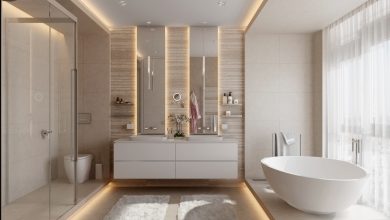


For decades, bathroom design focused heavily on the vertical and horizontal planes that immediately meet the eye. Designers poured immense resources into selecting natural stone flooring, custom vanities, and intricate shower tile compositions. Meanwhile, the ceiling remained an afterthought, universally coated in flat white paint and embedded with standard recessed lighting.
In contemporary luxury home design, this paradigm has shifted completely. Discerning homeowners and high-end interior architects now view the ceiling not as a utility boundary, but as a blank canvas. Often referred to as the fifth wall, a statement ceiling has become a hallmark of luxury bathroom design. Treating this overhead surface with the same artistic and architectural rigor as the rest of the room transforms a functional space into an immersive, sanctuary-like experience.
Architectural Manipulations: Redefining Spatial Dynamics
The most permanent and visually arresting way to create a statement ceiling is through structural and architectural modifications. Altering the physical shape of the ceiling changes how light moves through the bathroom and dictates the overall volume of the space.
Barrel Vaults and Groined Ceilings
A barrel vault, which resembles a continuous arched tunnel, introduces classical elegance and a sense of soft, flowing movement to a luxury bathroom. When executed in stone, plaster, or tile, a vaulted ceiling draws the eye upward, making the room feel grander. For an even more complex aesthetic, a groined ceiling—formed by the intersection of two barrel vaults—creates dramatic architectural angles and shadow lines, perfect for positioning over a freestanding soaking tub.
Coffered and Tray Ceilings
Coffered ceilings utilize a grid of recessed panels bordered by ornamental beams. This style brings a sense of traditional, structured luxury to large master bathrooms. By painting the interior panels a different shade than the beams, or by filling them with metallic leafing, you create depth.
Alternatively, a tray ceiling features a single central section that is recessed several inches higher than the perimeter. This configuration is highly functional in bathrooms, as the dropped perimeter provides a hidden cavity to run necessary HVAC ductwork, mechanical systems, and ambient LED cove lighting without sacrificing center-room height.
Material Innovation: Surface Treatments with Impact
When structural alterations are not feasible due to a home’s existing framing, surface materials offer a powerful alternative for creating a commanding fifth wall. The selection of materials must balance visual opulence with the practical realities of high-moisture environments.
Architectural Millwork and Wood Finishes
Introducing natural wood to a bathroom ceiling brings warmth and organic texture, contrasting beautifully with cold porcelain, glass, and marble surfaces.
-
Teak and Ipe: These exotic hardwoods naturally resist moisture, rot, and warping due to their high oil content, making them ideal for spa-like bathrooms.
-
Tongue-and-Groove Planking: Installing cedar or white oak planks across the ceiling creates lines that can visually elongate or widen a room depending on their orientation.
-
Reclaimed Wood Beams: For a rustic luxury or transitional aesthetic, incorporating heavy, rough-hewn timber beams across a plaster ceiling establishes an immediate architectural anchor.
High-End Wallcoverings and Murals
Modern adhesive technologies and vinyl-coated substrates have made it possible to safely introduce wallpaper to the bathroom ceiling, provided the room features a high-performance ventilation system.
Choosing a bold geometric pattern, a metallic grasscloth, or a custom panoramic mural overhead creates an unexpected focal point. Because the ceiling does not suffer from the same splash risks or direct water contact as the walls, it is the perfect location to showcase delicate patterns that might otherwise be ruined near a vanity or shower.
Intricate Tilework and Mosaics
Extending wall tile continuously onto the ceiling eliminates visual breaks, wrapping the user in a cohesive capsule of luxury. Glass mosaics, iridescent mother-of-pearl tiles, or book-matched slabs of dramatic marble overhead turn a walk-in shower or a tub alcove into an architectural masterpiece. When high-gloss or reflective tiles are used on the ceiling, they bounce ambient light around the room, making dark bathrooms feel noticeably brighter.
The Intersection of Lighting and the Fifth Wall
A statement ceiling cannot achieve its full potential without an integrated, meticulously planned lighting design. In a luxury bathroom, lighting should never simply blast down from the center of the room. It must illuminate the architectural features of the ceiling itself while setting a relaxing mood.
Hidden Cove Lighting
By embedding dimmable LED strip lighting inside the lip of a tray ceiling or behind crown molding, you create a glowing halo effect. This indirect illumination bounces off the ceiling surface, washing the room in a soft, ambient glow that eliminates harsh facial shadows in the vanity mirrors. It also serves as ideal low-level illumination for a relaxing midnight soak.
Statement Chandeliers and Pendants
The fifth wall serves as the launching pad for spectacular light fixtures. A crystal chandelier positioned over a freestanding tub, or a cluster of sculptural blown-glass pendants dropping down from a high vaulted ceiling, creates a dramatic centerpiece. When choosing fixtures, ensure they are rated for damp locations and hung at a height that complies with safety codes regarding clearance above water levels.
Sky-Simulation and Fiber Optics
For the ultimate bespoke luxury experience, designers are increasingly embedding fiber-optic lighting networks into plaster ceilings to mimic a night sky. These systems can be programmed to display constellations, twinkle softly, or shift colors, transforming a routine bath into a sensory escape.
Practical Engineering for Luxury Bathrooms
While aesthetics are paramount, a statement ceiling in a luxury bathroom will quickly deteriorate if the underlying environmental engineering is neglected. The combination of steam, heat, and moisture requires strict adherence to building best practices.
Advanced Ventilation Strategies
To protect expensive plaster work, custom millwork, or high-end wallpaper on a ceiling, you must install a high-capacity, low-sone inline ventilation fan. Standard bathroom fans are often insufficient for large, luxury layouts. An inline remote blower fan pulls air quietly and efficiently through multiple discrete registers on the ceiling, exhausting moisture before it can condense on premium finishes.
Substrate Preparation
Any drywall used on a luxury bathroom ceiling must be moisture-resistant, commonly referred to as greenboard or purpleboard. In steam showers or wet rooms where the tile extends onto the ceiling, a cement backer board coupled with a high-grade elastomeric waterproofing membrane is mandatory to prevent water vapor from migrating into the wooden joists above.
Frequently Asked Questions
How high must a bathroom ceiling be to successfully implement a statement design?
While a minimum height of 8 feet is standard for residential construction, statement designs like coffered grids or dark wood paneling show best on ceilings that are 9 feet or higher. On standard 8-foot ceilings, it is wiser to use flush surface materials, high-gloss paint, or soft tray outlines to avoid making the room feel cramped or claustrophobic.
Will wood ceilings in a bathroom warp or develop mold over time?
Wood ceilings will remain pristine if you use the correct species and finishes combined with proper ventilation. Hardwoods like teak, cedar, and ipe naturally resist moisture. Furthermore, back-sealing the planks before installation and applying a marine-grade polyurethane topcoat prevents humidity from penetrating the fibers, eliminating the risk of warping and mold.
Is it safe to install a heavy crystal chandelier over a soaking tub?
Yes, but it must comply with strict building codes. The National Electrical Code requires that any part of a hanging light fixture must be at least 8 feet above the top of the bathtub rim, or 3 feet horizontally from the tub zone. If your ceiling height does not allow for this clearance, the fixture must be explicitly rated for wet locations and protected by a Ground Fault Circuit Interrupter.
What paint finish is best for a flat statement ceiling in a master bath?
To make a flat ceiling stand out, designers often use a high-gloss or semi-gloss finish. High-gloss paint reflects light beautifully, mimicking the sheen of polished stone. However, gloss finishes reveal every single imperfection in the drywall work, meaning the ceiling substrate must be skim-coated to a flawless Level 5 finish before painting.
How do I clean and maintain a tiled or wallpapered bathroom ceiling?
Tiled ceilings should be wiped down periodically with a microfiber mop and a mild, non-abrasive cleaner to prevent soap scum or mineral deposits from forming. For wallpapered ceilings, vacuuming with a soft brush attachment removes dust, and any smudges can be gently blotted with a slightly damp sponge, provided the wallpaper is rated as washable or scrubbable vinyl.
Can I add a skylight to a statement ceiling without ruining the design?
A skylight can actually serve as the ultimate statement piece for a fifth wall. Framing a skylight within a deep, flared light well adds structural depth to the ceiling. Positioning it directly over a shower or tub allows you to stargaze or look at the clouds, integrating the natural outdoor environment directly into the architectural theme of the room.