
When a storm floods your basement with several feet of sewage-tainted water or slices open the roof, your primary duty is to make whatever emergency response actions are necessary to prevent further damage or loss of life. After that, take a deep breath and a few minutes to make a plan. Your stuff is wet (or worse), your dwelling is a mess, and it’s all so overwhelming and just so sad, but this can be fixed better than it was before if you can make yourself pause and think.
Before you touch anything: safety and documentation
Do not attempt to enter any flooded space until you have it verified that the electricity has been turned off. Not just the breaker you can see, but the entire electrical panel. Water and electricity are a lethal combination, and we lose dozens of people to electrocution every year just because they didn’t want their iPhone to get wet.
If it’s safe to enter, start with documentation. Photograph and video every room before you touch or remove a single item. Every damaged object or piece of furniture, every waterline on a wall, every square yard of carpet or inch of damaged flooring. The best offense is a good defense and photo logs of pre-cleanup conditions can make a massive difference in insurance claims. They can invalidate the entire RCV claim simply from a lack of being able to see what it looked like before the trucks showed up. Don’t let that happen. Document everything.
Also consider structural assessments prior to people and equipment being moved in. Heavy water exposure can weaken walls to the point where they may not support water extraction equipment or humans on Wet-Vacs until they have been professionally repaired and reinforced. Common signs include subtle bowing or widening of door frames and wall/floor seams, floors feeling “spongy” due to minor foundation shift, etc. If you see these signs, back out and call a structural engineer to inspect before you start cleanup and demolition.
The 24 to 48 hour window
This is what professionals call the mitigation phase – stopping further damage from occurring. Mold spores are always present in the air. What they need to colonize is moisture and a porous surface. Drywall, wood framing, and carpet backing give them both. Under the right conditions, visible mold growth can begin within 24 to 48 hours. Secondary damage from mold – and from wood rot, which follows on a similar timeline – is almost always more expensive than the original water damage.
This is where local professional response makes a measurable difference. A team handling water damage lakewood residents deal with can reach the property faster, begin extraction sooner, and prevent the kind of permanent structural failure that occurs when wet framing sits untreated through a weekend.
Why drying is a science, not a task
Opening windows and running box fans isn’t drying – it’s moving air. Actual drying requires a calculated balance of air movement, dehumidification, and temperature that draws moisture out of building materials, not just off the surface. The field has a name for this: psychrometry. Technicians trained to IICRC standards understand how air temperature and relative humidity affect the rate at which materials release trapped moisture. They use moisture meters to find water behind drywall and under subflooring that you can’t see or feel. Then they place industrial dehumidifiers – machines that can remove gallons of water vapor from the air each day – in a configuration designed for that specific space. Household dehumidifiers work for basements on a humid summer day. They don’t work for post-flood structural drying. The math doesn’t support it.
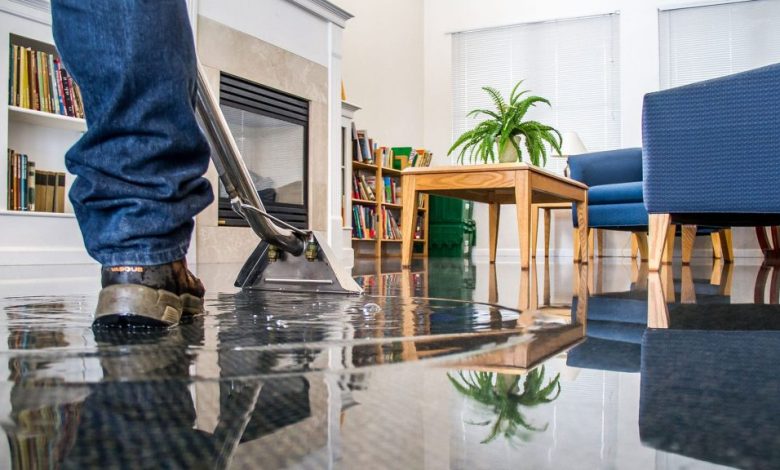
The same logic applies to carpet. According to FEMA, just one inch of floodwater can cause up to $25,000 in damage to a typical single-story home – and a significant portion of that damage comes from water that soaks through carpet and pad into the subfloor. Household wet-vacs can’t generate the suction lift needed to extract water from those lower layers. Professional extraction equipment can. That difference, in many cases, determines whether the subfloor is salvageable.
Dealing with contaminated water
All floodwater is not the same. If the flood source was sewage backup, storm drain overflow, or a sump pump failure allowing groundwater to seep in, you’re likely dealing with Category 3 water, aka black water, which contains pathogens and necessitates biohazard-level treatment protocols.
You can’t clean Category 3 contamination with household disinfectants. Contents and materials that have absorbed the water, such as drywall, insulation, and carpet, typically must be removed. Crews use HEPA filtration air scrubbers to control airborne pathogens during the demolition. This is not a place to cut corners; health problems resulting from unaddressed biohazards can come to the surface months or even years later and are extremely difficult to document for an insurance claim.
Getting back to normal
Starting repairs, replacements, and rebuilding can only commence once the structure has dried out and any contaminants have been eliminated. If you begin rebuilding while moisture is still present, that’s how your house will have recurring mold issues.
The homes that rebound most quickly after weather events are almost universally not the homes where owners try to go the DIY route. They’re the homes where the right professionals get on site in the right order, typically starting on the interior within those first couple of days.